July 30, 2026
Principle Four: Diversity, Breaking the Monoculture Cycle
By Bryan Jorgensen, Visionary - Ideal Soil Solutions
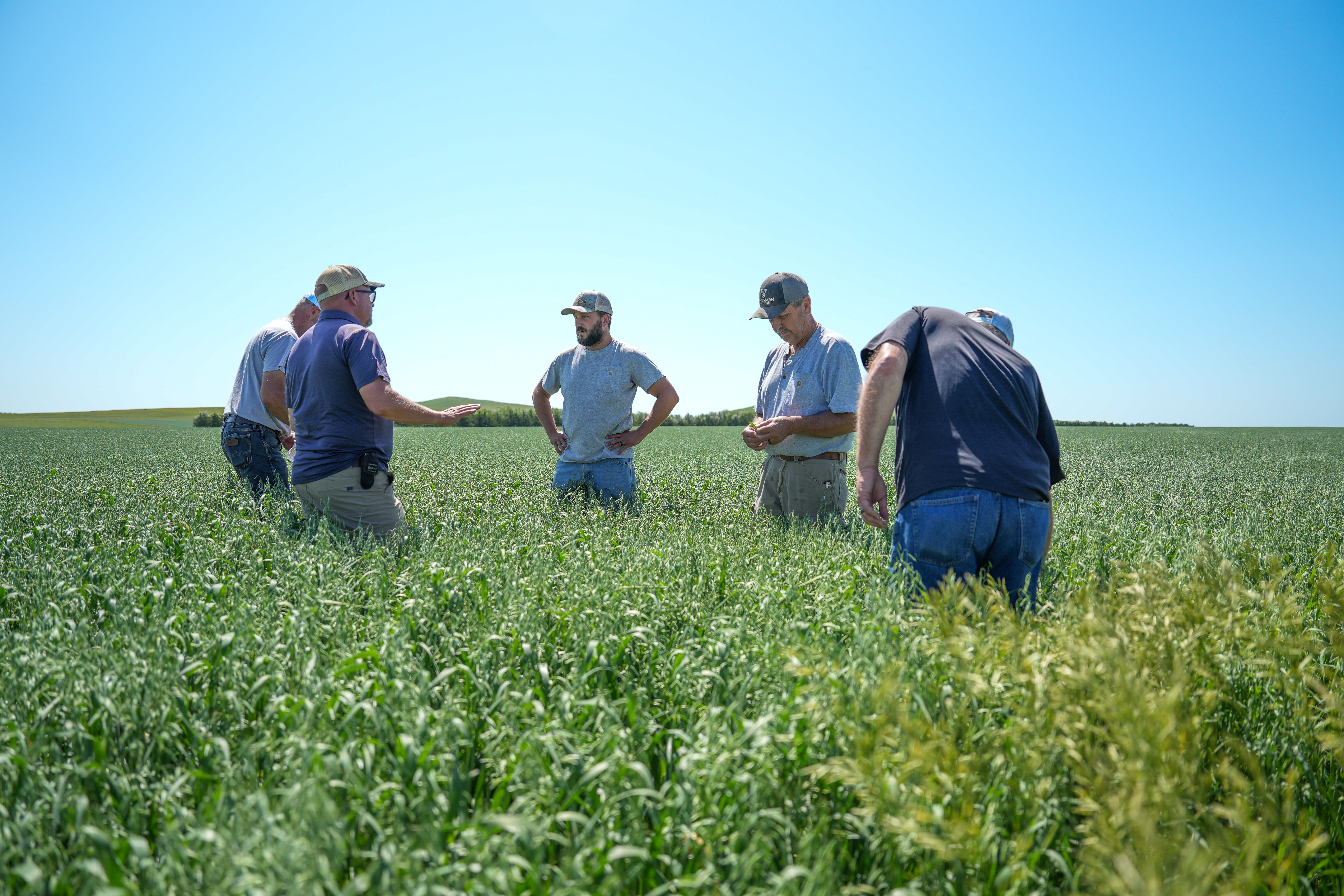
Of all five principles, diversity is probably the one that most closely mirrors what a native prairie has been doing for thousands of years without any help from us. That system has sustained itself because it’s built on a diverse set of plants: cool and warm season grasses, cool and warm season broadleaves, all intermingling at different points in the year. Some help each other, some don’t, but together they create a shifting environment for the microbes and insects living in that soil, one that’s continually rotating and staying healthy.
A cropping system looks nothing like that by default. Most of what we grow, corn, soybeans, wheat, alfalfa, is grown as a monoculture. There’s nothing inherently wrong with any one of those crops on its own. The problem is what’s missing: nowhere in nature does a single species grow completely by itself, and when we set our systems up that way, we’re working against how the whole system wants to function.
What monoculture invites
Here’s what happens over time in a system built on similar, repeating crops, corn and soybeans being the classic example: both planted in spring, both warm season, both harvested in fall, with roughly half the year completely inactive in between. Nature notices that pattern quickly, and she inserts things to break it apart, whether that’s insects, disease pressure, or aggressive weed cycles. She’s pushing for a more dynamic system, whether we’ve planned for one or not.
Adding a cereal grain into that rotation helps, because it brings a different planting window, a different maturity cycle, and a different root structure into the mix. Adding cover crops helps even more, because it diversifies the system further still. Neither is easy to fit into a tight schedule, but both work with the pressure nature is already applying instead of against it.
Thinking about soil biology like a rumen
If you’ve worked with ruminant nutrition, this comparison will make sense: think about the range of microbes living in a rumen, each one fed by a different component of the diet you’re providing. Soil works the same way. A diverse set of plant roots feeds a diverse set of microbes, each one dependent on certain elements that specific plants provide. Take those plant species out of the system, and the microbes that depended on them are less likely to survive either.
The more diverse the plant system above ground, the more diverse the biological community below it. Run a true monoculture, and you’ve put a ceiling on how diverse that biology can ever become.
How this shows up in our rotation
At Jorgensen Land & Cattle, we generally spend no more than two years in a similar crop type before moving at least two years away from it. A typical sequence might run spring wheat or oats, into winter wheat, into two years of corn, and then either back to a cereal grain, into soybeans, or into alfalfa. Stretching those intervals out, rather than running a straight corn-bean-corn-bean cycle, breaks up disease, weed, and insect cycles that build momentum in a tighter rotation. It also opens up more windows to slot in a cover crop, which stacks diversity with living root time in a single pass.
Building a real cover crop blend
A cover crop itself shouldn’t be a monoculture either. The first thing to consider in any blend is the carbon to nitrogen ratio, keeping it under roughly 20-22 to 1, so you’re not loading up on slow-to-degrade, high-carbon species or fast, low-carbon ones exclusively. Beyond that ratio, the more species you bring to the mix, warm and cool season grasses, warm and cool season broadleaves, brassicas, legumes, forbs, the more natural and functional that system becomes.
A well-built blend does several things at once: it scavenges excess nutrients sitting in the soil that would otherwise go to waste, it conditions the soil physically, it extends the living-root window, and, where livestock are part of the picture, it opens up a real grazing opportunity. That last point is where a lot of the economic payoff shows up, and it’s worth its own conversation.