July 30, 2026
Principle Two: Low Disturbance, Necessary vs. Habitual
By Bryan Jorgensen, Visionary - Ideal Soil Solutions
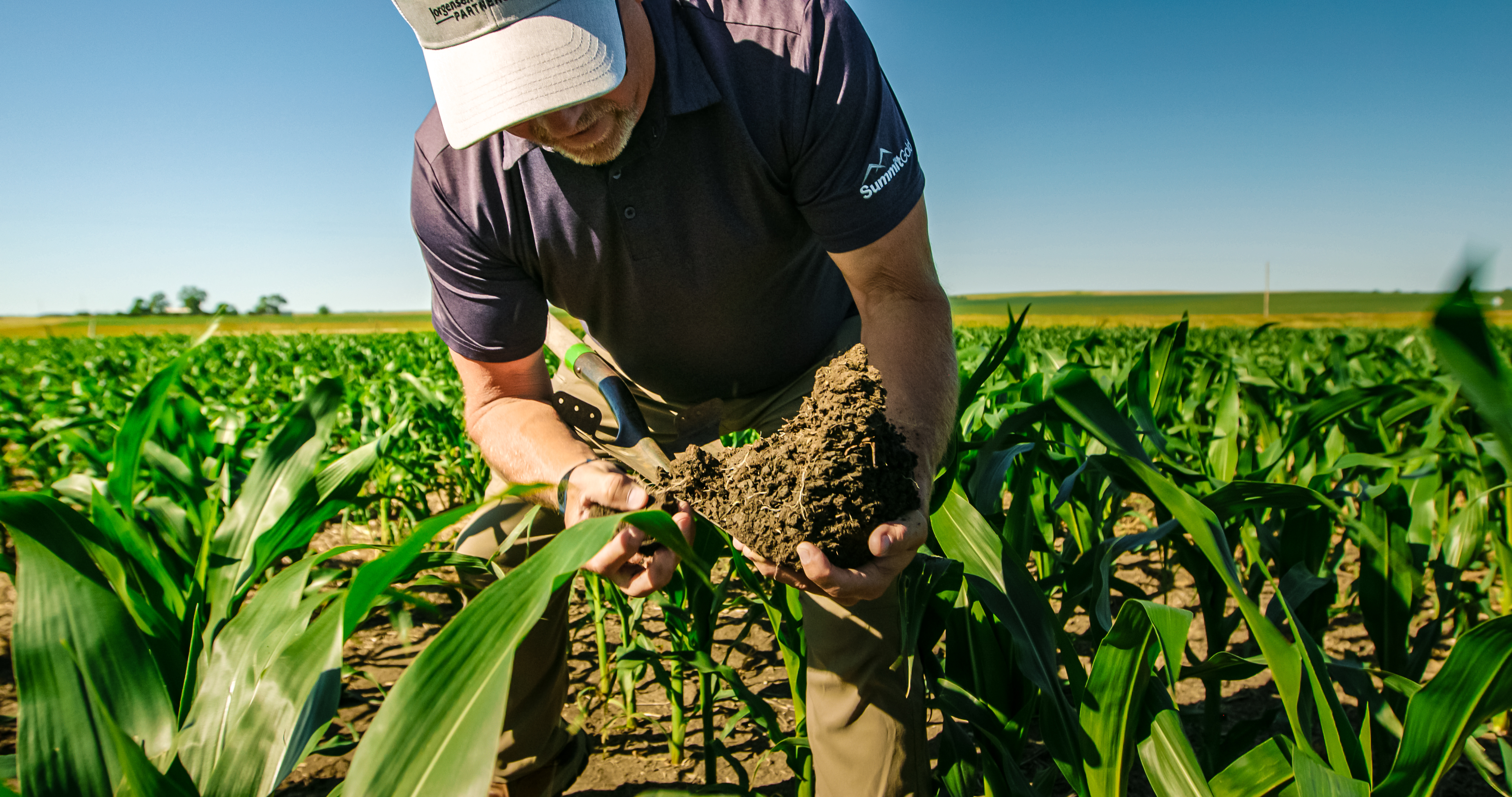
When most people hear “disturbance,” they think tillage. They’re not wrong, but that’s a fraction of what disturbance actually means.
A disturbance is anything that affects the chemical, physical, or biological portion of your soil. In a pasture, that’s overgrazing, a fertilizer application, an insecticide application. In a crop field, it’s planting, spraying, combining, grazing: every activity we do is technically a disturbance of some kind. That doesn’t mean every disturbance is bad. Some are necessary, both economically and ecologically. What matters is understanding how much disturbance an activity creates, and whether it’s worth it.
The rule I run by: the lowest amount of disturbance is always better. Any disruption starts creating an imbalance somewhere in the system; the question is just whether the tradeoff is worth what you get out of it.
The most common disturbances
Every time equipment or livestock crosses a field, you’re creating a compaction event, whether it’s a tractor tire or a hoof. Compaction compresses oxygen out of the soil colloid. Aerobic microbes need oxygen and water to function, so when you compact soil, you create an anaerobic environment those microbes can’t survive in. You’ve squeezed out the moisture, and you’ve reduced the soil’s ability to take in water and oxygen and support biological life going forward.
Fertilizer placement is a disturbance too: even a small band of nitrogen or phosphorus beside a row changes the chemical environment in that microcosm. Overgrazing is a classic pasture-level disturbance: too many cattle, too long, in too small a space. They eat the vegetation down and compact the soil at the same time, and it takes far longer for both the plant and the soil to recover.
Full tillage is the big one. It disrupts the natural web of microbes and fungi that build up in a no-till system, an extremely complex environment that gets blown apart the moment steel turns it over.
Necessary vs. habitual
This is the distinction that matters most. How often is tillage actually necessary versus just something we do out of habit?
It depends heavily on geography. In an arid environment like ours (south central South Dakota), under 22 inches of rainfall a year, we’re conserving every bit of moisture we can, and tillage works against that. Farther east, where rainfall is heavier and moisture isn’t the limiting factor, some tillage may genuinely be necessary just to get equipment into a field. Even there, I don’t recommend full tillage; I’d recommend strip till, where you darken and loosen a narrow strip to plant into, warming the soil faster in spring without disturbing everything else.
At JLC, we made the full jump to no-till in 1991. I went so far as to take the wheels off our tillage equipment so it wouldn’t be a temptation to drag it back out.
We saw changes fast, even before we understood exactly what “soil health” meant. We weren’t trying to fix specific imbalances; we were just trying to save moisture, time, and money. But we saw it working. By the mid-90s, we started rethinking our fertility program entirely: less dry fertilizer spread on the surface, and in some cases none at all. Instead, we moved to putting smaller amounts of nitrogen and phosphorus directly beside or in the row through the planter or air seeder. That single change did three things at once: it eliminated a separate application pass, it let us cut nutrient concentration by 30 to 50 percent, and it placed the nutrient exactly where the plant could use it most efficiently. Our first air seeder with that capability, purchased around 2006, saved us roughly $80,000 in application costs alone; it paid for itself in one season.
What that looks like on our corn planter today
Our planter uses a double-disc opener that cuts a thin slice through residue and places seed exactly where we want it, moving just enough residue to avoid hairpinning without exposing bare soil. Four inches to the side, a single-disc opener places a band of nitrogen and sulfur, about 60 to 65 pounds, stabilized with a kelp-based product, and that band is all the nitrogen that plant gets for the season. The sulfur acidifies that band slightly, which is itself a disturbance, but a good one: it helps microbes mineralize nutrients more effectively. The seed gets an orthophosphate, immediately available even in cold, wet conditions, along with a microbial inoculant that colonizes the root and starts nutrient transfer right away.
All of that is disturbance. But it’s targeted, efficient disturbance that outweighs the deficiency it’s solving, while the rest of the field surface stays covered, undisturbed, and dark-spot free.
Good soil biology can do what steel used to do. We’re not sacrificing what the system can produce. We’re just letting it do more of the work on its own, with the right input in the right place at the right time.